Atlassian Connect Ends on 31 January 2027: What Happens to Your Jira and Confluence Apps
Atlassian ends support for Connect on 31 January 2027. Here is what that date actually changes, how to check which of your Jira and Confluence apps are affected, and what to do about each one.
If you run Jira or Confluence Cloud, some of the apps your teams rely on were probably built on Atlassian Connect. On 31 January 2027, Atlassian ends support for Connect.
That date is close, and it's easy to misread. Your apps won't all switch off at midnight. But from then on, anything still on Connect runs on a platform nobody is maintaining, and the risk grows every month after.
This article explains what changes, who is affected, how to check your own site in about half an hour, and what to do about each app you find. It's written for Jira and Confluence admins, for the people who own a custom Connect app, and for vendors still deciding what to do.
Connect and Forge in one paragraph
Atlassian has two platforms for building apps that extend Jira and Confluence. Connect is the older one: the vendor hosts the app on their own servers, and its screens load inside Jira through an iframe. Forge is the newer one: the app runs on Atlassian's own infrastructure, declares the permissions it needs up front, and gets every new capability Atlassian ships, from new UI components to Rovo and AI features. Atlassian is retiring Connect and moving the whole ecosystem to Forge.
The timeline
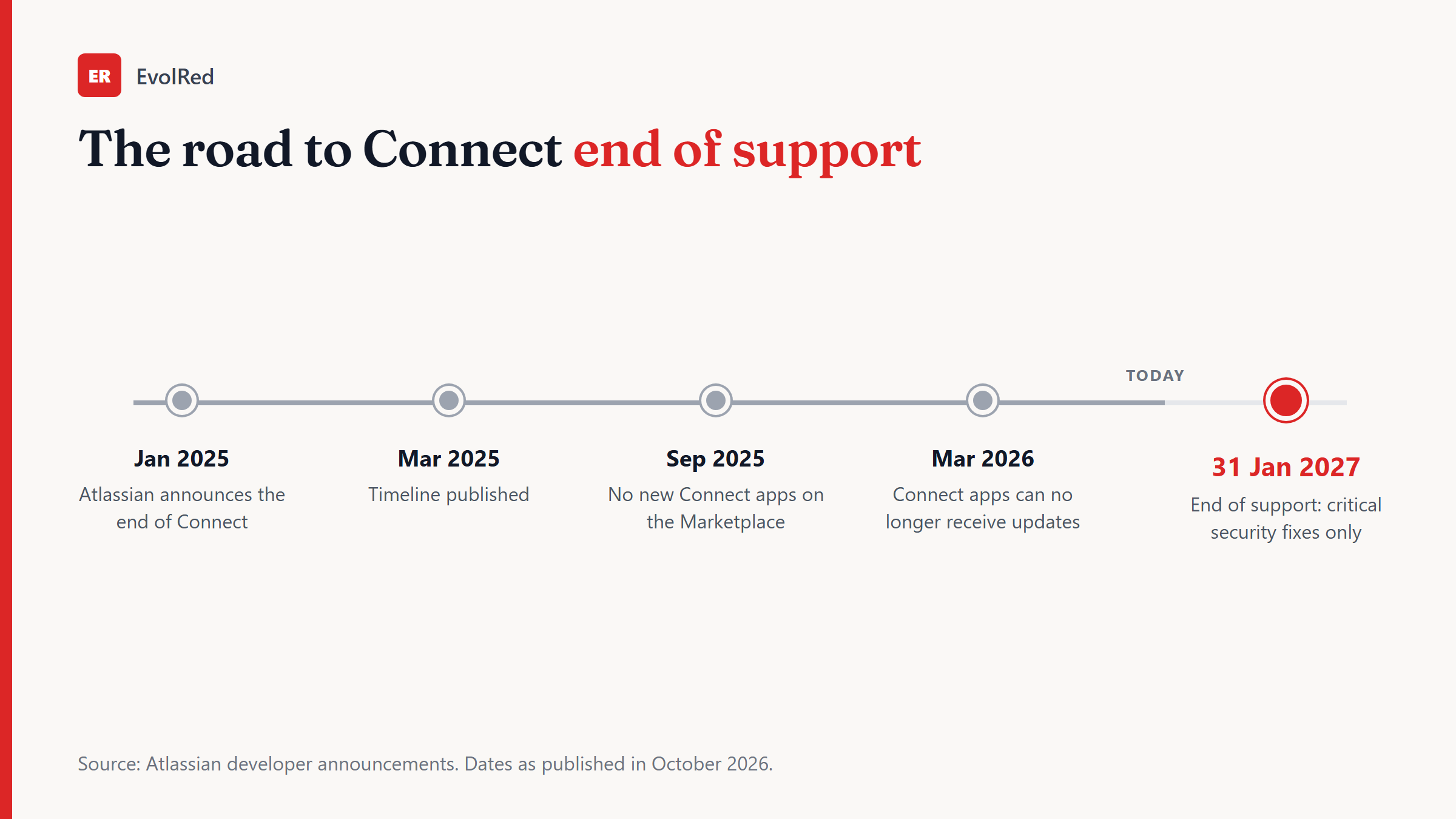
Atlassian has been phasing Connect out step by step:
- January 2025: Atlassian announces its intent to end support for Connect.
- March 2025: the end-of-support timeline is published.
- September 2025: new Connect apps can no longer be listed on the Marketplace. Existing apps keep working.
- March 2026: apps that still use a Connect descriptor can no longer receive updates. Every change now has to ship through Forge.
- 31 January 2027: Connect end of support. Atlassian moved this date from December 2026 to give teams room around the holidays and annual planning.
The full announcement and Atlassian's guidance are on its developer blog.
What actually happens on 31 January 2027
End of support is not a kill switch. It's the point where Atlassian stops looking after the platform. In practice, that means:
- Only critical security issues get fixed. Ordinary bugs in Connect itself stay unfixed.
- Connect stops evolving with the rest of Atlassian. New Jira and Confluence features, UI changes and APIs are built for Forge. Each one is a chance for something on Connect to stop working properly.
- Breakages become more likely over time, and the gaps between what Connect apps can do and what the products expect will keep widening.
- Admins already see warnings. Jira and Confluence show a notice in the apps section for apps still on Connect. Some sites show December 2026 because of the original date; the current date is 31 January 2027.
So the honest answer to "will my app break on 1 February?" is: probably not that day. But you'll be running something that gets less safe and less reliable every month, with no promise of a fix when it fails. For an app that sits in the middle of how your teams work, that's a risk worth removing on your own schedule rather than during an outage.
Who is affected
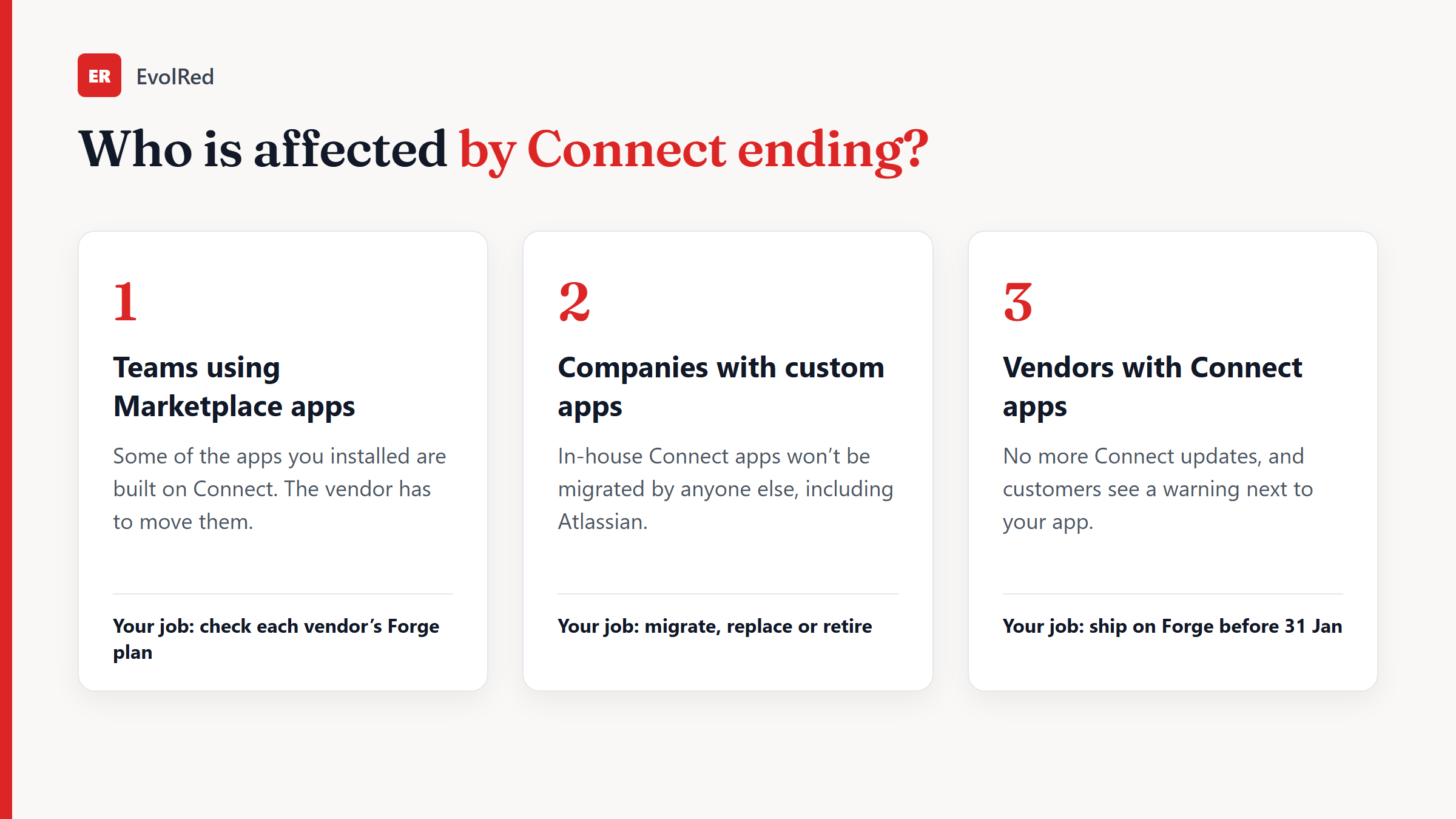
1. Teams using Marketplace apps. Most companies are here. You installed apps from the Atlassian Marketplace, and some were built on Connect. The vendor has to move them to Forge. Your job is to find out whether they're doing it, and when.
2. Companies with custom or private apps. If your company built its own Connect app (an integration with an internal system, a custom workflow screen, a reporting panel), nobody else is going to migrate it. Atlassian won't rewrite it for you. It's yours to move, replace or retire. Atlassian has specific guidance for custom apps.
3. Vendors with Connect apps on the Marketplace. If you sell or publish a Connect app, you can't ship updates through Connect any more, and your customers' admins are seeing the warning next to your app's name. Every week without a Forge plan is a week your customers start looking at alternatives.
Check your site in 30 minutes
You don't need a project to find out where you stand. An admin can do this in one sitting:
- List your apps. In Jira and Confluence administration, open the apps section and note every installed app, including ones built in-house.
- Look for the Connect warning. Atlassian marks apps still on Connect. Write down each one that has the notice.
- Check what each vendor has said. Most vendors have published a Forge statement on their Marketplace listing, documentation or community page. Note the planned date, or the lack of one.
- Find the owners of anything custom. For in-house apps, find out who built them, where the code lives and whether anyone can still change it.
- Rate each app by importance. Is it critical (work stops without it), important (painful to lose) or nice to have?
You end up with a short list, and that list tells you what to do next.
What to do about each app
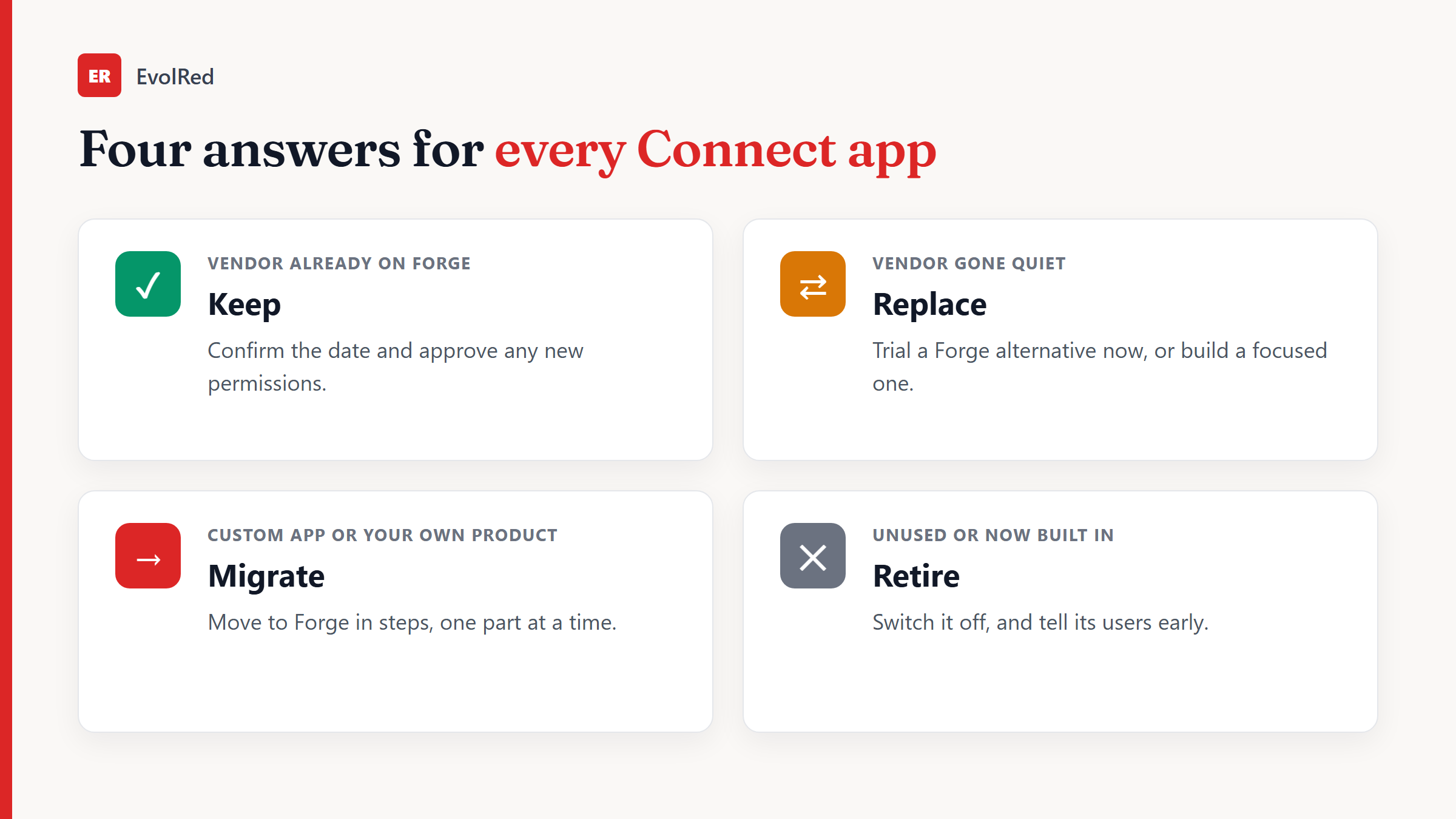
Every app on your list fits one of four answers:
Keep. The vendor has already moved the app to Forge, or has a credible plan with a date before the deadline. Confirm the date, and check whether the update needs you to approve new permissions. Forge apps declare their permissions up front, so admins sometimes have to accept a change.
Replace. The vendor has gone quiet, or the app is no longer maintained. Look for a Forge alternative on the Marketplace now, while you have time to trial it and move your data. If nothing fits, a small custom Forge app is often less work than people expect, especially when you only use a slice of what the old app did.
Migrate. This is the usual answer for custom apps and for vendors. Move the app to Forge. Atlassian's adoption path lets you put the existing app on a Forge manifest first, then replace its Connect parts one at a time, instead of doing one big switch.
Retire. Some apps should not move. If Jira or Confluence now does the same job natively, or almost nobody uses the app any more, switching it off is the cheapest and safest option. Say so early, so the people who do use it have time to adjust.
Why migrations take longer than they look
The most common mistake we see is treating a Connect-to-Forge migration as a port: same app, new wrapper. For very simple apps that's true. For most, parts of the app have to be redesigned, because Forge works differently:
- Runtime. Forge functions are short-lived and stateless. A Connect endpoint that crunched through 40,000 issues in one go has to become a series of steps.
- Storage. Forge storage has limits per key. Data that grew freely in your own database for years may need a new shape.
- Outbound calls. Every external system the app talks to has to be declared, and a security-conscious customer will ask about each one.
- UI. Forge places screens in a defined set of locations. A few Connect layouts have no direct equivalent and need a different design.
- Cost. Since January 2026 Forge has consumption-based pricing, with a free monthly allowance that most small and medium apps stay inside. Heavy apps need an estimate.
None of these is a reason to panic, but each one adds time, and together they're why we tell people to start in November rather than January. We go into the engineering detail in The Connect Cliff Is Closer Than the Marketplace Leaderboard Suggests and Forge vs Connect in 2026.
How EvolRed can help
We build on Forge every day. Our own Jira apps (LicenseGuard, Blocker Status, Epic Progress Bar and Issue Link Counter) all run on Forge and are live on the Atlassian Marketplace, and we've been on the platform since before it had a Marketplace. Every project is led by the founder, with trusted senior engineers brought in for the work, and we stay on for support after launch.
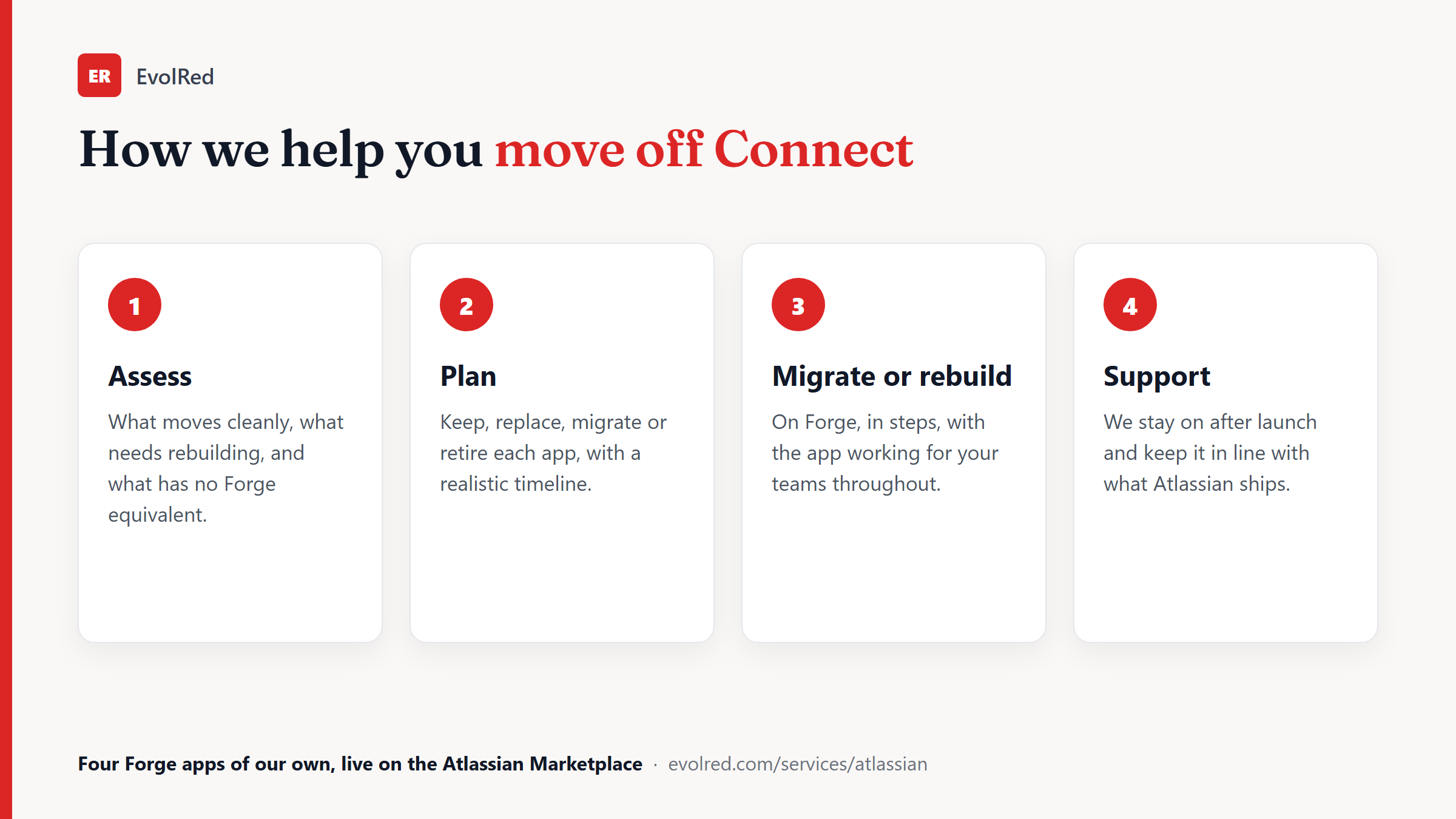
Depending on where you are, we can help with:
- A Connect assessment. We go through your site, or your app, and come back with a clear list: what moves cleanly, what needs rebuilding, what has no Forge equivalent, and what we'd retire. You get a plan and a realistic timeline, whoever ends up doing the work.
- Migrating a custom or private app. We move your in-house Connect app to Forge in steps, keeping it working for your teams throughout, and hand the code over in your repository.
- Replacing an app whose vendor has gone quiet. If a Marketplace app you depend on isn't coming to Forge, we can build a focused Forge app that does the part your teams actually use.
- Vendor migrations. For Marketplace vendors: architecture, storage redesign, data migration, the permission changes your customers will see, and the Marketplace transition.
- Support after the move. We keep the app running, updated and in line with what Atlassian ships next.
We'll tell you plainly if something shouldn't be migrated at all. Sometimes the most useful outcome of an assessment is a shorter list.
The short version
- Connect support ends on 31 January 2027. Apps won't vanish that day, but they'll run on an unmaintained platform with growing risk.
- Check your site now: list your apps, find the Connect warnings, and check each vendor's plan.
- For each app, decide: keep, replace, migrate or retire.
- Custom apps are your responsibility. Start them first.
Still running a Connect app, or not sure which of yours are affected? Talk to us about a Connect assessment, or see our Atlassian development services.
Related articles
Forge vs Connect in 2026: Connect Is Ending. Here Is What That Changes
Atlassian ends support for Connect on 31 January 2027. For new apps the choice is made, and for existing Connect apps the question is no longer whether to move to Forge, but how. Updated October 2026.
8 min readThe Connect Cliff Is Closer Than the Marketplace Leaderboard Suggests
Half the paid apps in the Atlassian Marketplace are still on Connect. The migration to Forge is harder than the migration guide implies, the timeline is shorter than vendors are pricing in, and a meaningful number of apps probably should not migrate at all.
10 min readJira Custom Fields: The Hidden Performance Cost Nobody Warns You About
Custom fields are the easiest thing to add in Jira and one of the most expensive. Here is why your instance slows down as the field count grows, and what to do about it.
7 min read